A peeling leather jacket usually isn’t “the leather falling apart.” In most cases, a surface layer is failing, either a protective finish on real leather, or a polyurethane-style coating on faux/bonded materials. Once that outer layer loses flexibility or loses its grip, everyday bending and rubbing turns a small weakness into visible peeling.
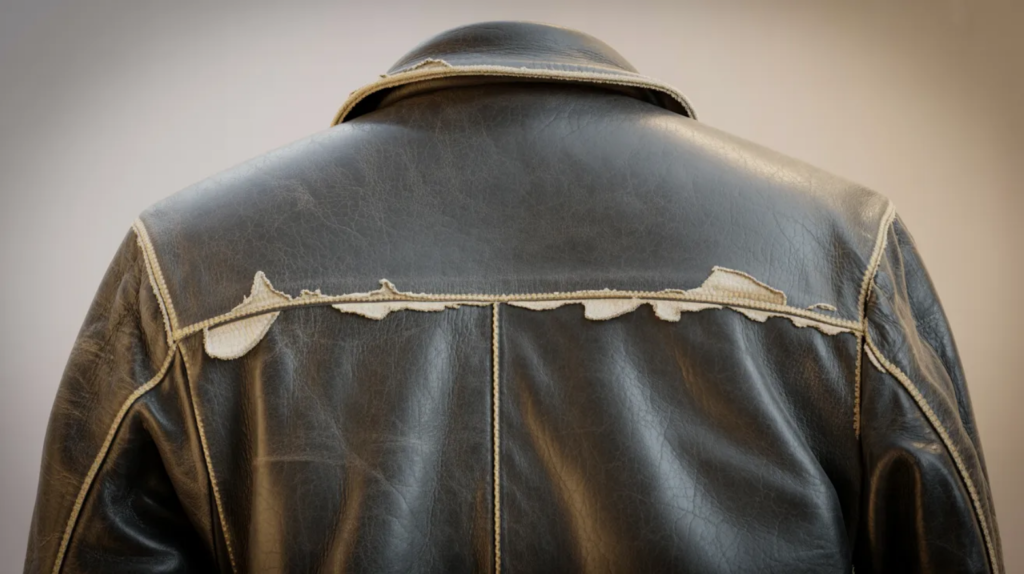
The good news is that peeling follows patterns. When you learn what kind of peeling you have, the cause becomes much easier to identify, and you stop wasting time on fixes that don’t match the material.
First, identify what’s actually peeling
Peeling tends to show up in two main forms, and each one points to a different root cause.
Finish failure on real leather or coated leather
Many genuine leather jackets have a surface finish built in layers. When that finish becomes brittle or chemically weakened, it can crack and flake. When the bond between finish layers weakens, it can lift like a thin film.
If you want a clean mental model of how that surface is built, it helps to understand the layers of a leather jacket finish first, because peeling often starts at the “weakest layer boundary.”
Delamination on faux, PU, bonded, or bicast materials
Synthetic “leather” is usually a composite: a fabric base with a coating on top. When that coating ages or breaks down, it can separate from the backing and peel in sheets. You often see a woven fabric underneath when it happens, which is why delamination vs surface flaking is such an important distinction before you choose a repair method.
A quick look test you can do in 10 seconds
If it peels like a thin skin
When the peeling lifts in smooth, flexible sheets (especially around creases), the jacket is often losing its clear protective layer. That pattern matches what happens when a topcoat starts separating from the layer beneath it, so each bend catches the edge and pulls it wider.
If it flakes like dry paint
When peeling looks like tiny chips, dust, or dry flakes, the surface usually became brittle first. Brittleness tends to build slowly from flexing stress, abrasion, heat, and harsh cleaning.
If fabric shows underneath
When you can see a woven backing or a different base layer, the coating has usually separated from the material under it. In that situation, the jacket is behaving like a layered composite, which is why the signs in delamination vs surface flaking often match what you’re seeing more than “dry leather” does.
If it starts around seams, patches, or past repairs
When peeling clusters around stitched edges, glued trims, badges, or older touch-up areas, it often points to bond weakening between surface layers, especially if the area had residue from waxy products or incompatible coatings.
Why peeling usually begins at elbows, cuffs, collars, and shoulders
A jacket moves constantly. Every wear session bends the same zones again and again:
- elbows and forearms
- shoulder tops and underarms
- collar edges
- cuffs and pocket rims
- zipper line and hem folds
Those areas experience two forces at the same time: flexing and friction. Flexing creates micro-cracks, friction widens them, and then the surface starts to lift. That’s why peeling often “starts small,” then seems to spread quickly once an edge forms.
The real causes of leather jacket peeling
1) The finish becomes brittle and can’t flex anymore
A finish needs elasticity. When it dries out, ages, or gets chemically weakened, it stops stretching with the jacket. The next bend becomes a crack line, and repeated bending turns that crack into flakes or lifting.
This is why a jacket that feels stiff in the peeling area often peels faster than a jacket that still feels supple.
2) Abrasion slowly grinds the surface until it lifts
A seat belt across the chest, a backpack strap on the shoulder, desk-edge rubbing on the forearm, these don’t feel dramatic day-to-day, but they create constant surface wear.
Abrasion often follows a quiet sequence:
- the sheen dulls
- the surface becomes slightly rough
- fine cracks appear
- the layer starts to peel along a crack edge
Once the edge lifts, normal movement keeps pulling at it.
3) Heat and sunlight accelerate finish breakdown
Heat dries and stresses surfaces. Sunlight fades pigment and weakens protective layers over time. When a jacket experiences repeated warm/cool cycles, like being left in a hot car or stored near a heater, the surface can lose flexibility faster than you’d expect.
That’s why a jacket can start peeling after repeated sun and heat exposure, often with early signs like dullness and fine cracking before the peel becomes obvious.
4) Humidity, sweat, and poor airflow weaken coatings over time
Moisture doesn’t always “soak” leather to cause damage. Long-term humidity and sweat create slow stress:
- salts and oils from sweat sit on the surface
- moisture cycles expand and contract coatings
- closed storage prevents the jacket from fully airing out
On coated and synthetic materials, those humidity cycles can contribute to separation and peeling, which is why peeling sometimes appears after a season of heavy wear even if the jacket wasn’t “mistreated.”
5) Harsh cleaning products weaken the surface layer
Some cleaning attempts damage the finish more than the original stain. Alcohol-heavy wipes, strong degreasers, acetone-like removers, and abrasive scrubbing can soften or strip protective layers.
A common pattern is “looks okay today, peels later.” The cleaner weakens the film, the film turns brittle, and then flex points begin to shed.
6) Manufacturing mismatch creates weak adhesion from day one
Sometimes the problem starts at the factory. If the finish layers didn’t bond well, peeling can start earlier than expected, sometimes in multiple areas that don’t match normal friction zones.
This type of peeling often looks like a clean film lifting rather than dusty flaking, which is why the mechanism behind topcoat separation fits these cases so closely.
7) Layer incompatibility after repairs, recoloring, or “quick shine” products
A jacket can peel after a repair because layers don’t always like each other.
A typical chain reaction looks like this:
- a waxy or silicone-rich product leaves a barrier
- a new coating sits on top instead of bonding
- bending cracks the new layer
- the cracked edge lifts and spreads
When that happens, the problem is rarely “bad luck.” It’s usually the surface losing grip at a layer boundary, which is exactly how adhesive and bond weakening tends to show up on jackets.
“Is my jacket real leather if it’s peeling?”
Peeling alone doesn’t prove it’s fake, but it’s a strong clue.
- Real leather often shows cracking, wear, and finish flaking, especially if the surface is heavily coated.
- Faux/PU/bonded materials often show sheet-like peeling with a backing layer visible underneath.
If you’re uncertain, the practical differences in delamination vs surface flaking are one of the fastest ways to confirm what you’re dealing with without needing labels or receipts.
Prevention that actually slows peeling (without overcomplicating it)
Peeling prevention is mostly about reducing surface stress:
- Keep it away from repeated heat blasts and harsh sun exposure.
- Let it breathe after wearing, especially if it absorbed sweat.
- Clean gently rather than aggressively, because finishes fail faster when they’re stripped.
- Notice friction hotspots early, because abrasion usually gives warnings before peeling begins.
When you catch the early stage, dullness, roughness, fine cracking, you can often slow the damage long before the peel becomes visible, which is why recognizing heat and sun finish breakdown early can save a jacket’s appearance.
Conclusion
A leather jacket peels because a surface layer fails, either by becoming brittle and cracking or by losing adhesion and lifting away. Real leather jackets usually peel when the finish layers break down, while faux and bonded materials often peel through delamination where the coating separates from its backing.
Once you match your jacket’s peeling style to the right cause, finish flaking, topcoat separation, bond weakening, or true delamination, the next steps stop feeling confusing, and the jacket stops feeling like a mystery you can’t control.