When a leather jacket starts peeling, it can feel like the leather itself is “coming apart.” In reality, the damage usually happens above the leather, in the finish system that gives the jacket its color, shine, and protection. Once you understand how those layers stack together, peeling stops being mysterious, and the pattern you’re seeing starts to make sense.
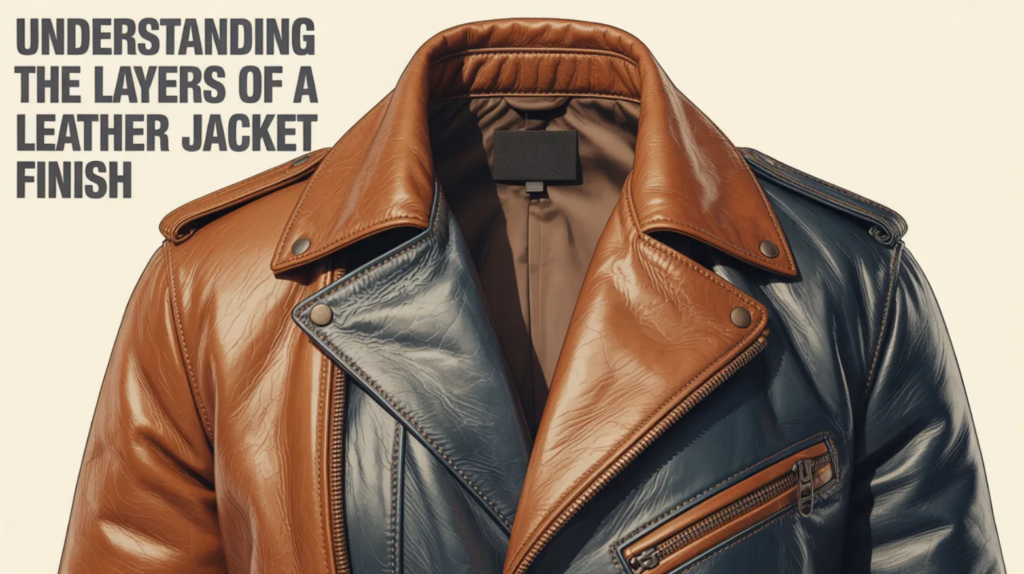
This page breaks down the main finish layers (base, color, topcoat, sealant), what each one does, and how each one fails in the real world.
The finish is a “system,” not a single coating
A jacket finish works like a protective skin. It has to do several jobs at once: hold color evenly, resist rubbing, survive flexing at elbows and cuffs, and handle the occasional rain drop or accidental wipe-down.
That’s why manufacturers rarely rely on a single coat. They build a layered finish, where each layer supports the next. When peeling happens, it usually means one layer lost strength or two layers stopped bonding, which is exactly what the main diagnosis hub on what causes leather jacket peeling is designed to help you identify.
Layer 1: The base layer (prep coat / basecoat)
The base layer is the “foundation.” It helps the surface become even, improves grip for color and protective coats, and can lightly fill tiny imperfections on corrected or coated leathers.
What the base layer does
- Creates a consistent surface so color applies evenly
- Improves adhesion between the leather and the layers above it
- Reduces patchiness on corrected-grain or heavily finished leather
- Helps the finish survive rubbing and repeated bending
How base-layer problems show up
Base-layer issues usually don’t look like a neat, clean peel at first. They often show up as:
- color wearing off unevenly in high-friction areas
- roughness that feels “thin” compared to surrounding panels
- peeling that returns quickly after a touch-up because the new layer has nothing stable to grip
When the base layer loses grip, the finish above it becomes vulnerable, which is why peeling that starts around seams and trims often points to surface layer bond weakening rather than “dry leather” alone.
Layer 2: The color layer (dye vs pigment)
Many people assume leather color is always “dye soaked into leather.” That’s sometimes true, but many jackets, especially fashion jackets with uniform color, use pigment-based color that behaves more like a flexible paint film.
Dye: color that penetrates
Dye is absorbed into the leather fibers. It tends to look natural and can age beautifully, because it’s not a thick surface film.
Dye-related wear often looks like:
- fading rather than peeling
- gradual lightening in high-wear areas
- a more “natural” patina effect
Pigment: color that sits on top
Pigment is color carried in a binder that sits on the surface. It gives a uniform look and can improve stain resistance, but it also creates a layer that must flex with the jacket.
Pigment-layer failure often looks like:
- small flakes or chips of color
- cracking at elbows and crease lines
- patches where color lifts and reveals a different tone beneath
If your jacket loses color and then starts shedding in fine flakes, you’re often looking at a finish film becoming brittle, which connects closely with clear-coat lifting and separation when the protective layer above the pigment stops holding together.
Layer 3: The topcoat (the clear protective finish)
The topcoat is the layer most people never think about until it fails. It’s usually clear (or slightly tinted), and it controls:
- gloss level (matte, satin, shiny)
- resistance to scuffs and rubbing
- water spotting and light staining
- that “smooth” feel when you run your hand over the jacket
A healthy topcoat acts like a flexible shield. A weak topcoat becomes the first thing that cracks.
What topcoat failure looks like
Topcoat failure often shows up in two distinct ways:
1) Flaking and micro-cracking
The surface becomes dull, then develops fine cracks, and then starts shedding in tiny flakes.
2) Film lifting (sheet-like peeling)
The clear layer lifts in thin sheets, especially around bends. Once an edge lifts, every movement pulls it a little farther, which is why jackets can look “fine” one week and suddenly start peeling the next.
That second pattern is the signature behavior of topcoat separation, where the clear protective layer loses adhesion to the color layer underneath.
Layer 4: The sealant (sometimes separate, sometimes built into the topcoat)
“Sealant” is a useful term, but it’s not always a separate product layer. On some jackets, the sealing function is built into the topcoat. On others, there may be an additional protective pass meant to improve stain resistance or lock in the feel.
Either way, the sealant’s job is emotional in a simple way: it keeps the jacket looking “finished,” so it still feels like your favorite piece instead of something fragile you have to baby.
What sealant failure looks like
When sealing protection breaks down, you may notice:
- water spotting more easily
- the jacket absorbing grime faster
- the surface feeling tacky after heat exposure
- dulling that doesn’t match the rest of the panel
Sealant breakdown often happens alongside environmental stress, which is why a jacket can start breaking down after sun and heat exposure even if you didn’t change anything else about how you wear it.
Why layers separate: the “bond line” is the weak point
In a layered finish, the most fragile point is often the boundary between two layers. That boundary is where grip, flexibility, and chemical compatibility matter most.
Layer separation tends to happen when:
- a finish becomes too brittle to flex
- the jacket experiences repeated abrasion in the same place
- heat and humidity cycles expand and contract the layers differently
- a waxy or silicone residue blocks proper bonding
- a repair layer is incompatible with the layer beneath it
When peeling looks clean and sheet-like, it usually means a layer is separating at a bond line, and that’s the exact behavior you see in bond weakening between surface layers.
How to tell which layer is failing on your jacket
You don’t need lab tools, just a calm look in good light.
If the peel is clear and thin
You’re likely seeing topcoat lifting. The surface may look like a clear film is coming off, and the area underneath may look slightly duller or a different shine.
If the peel carries color with it
If flakes include color (black, brown, tan), the color layer is involved. That often means the pigment layer has become brittle or the bond above it failed first.
If the surface turns dusty before it peels
Dusty shedding usually points to a brittle film breaking down in place, often from friction, dryness, or chemical weakening.
If fabric or a different backing shows through
That’s where you should pause and confirm you’re not dealing with a composite material. The behavior in delamination vs surface flaking is often the deciding factor when the damage looks deeper than “finish cracking.”
Why understanding layers changes your repair outcome
Two jackets can “peel,” yet require totally different approaches.
- If only the topcoat is failing, the surface may be restorable with the right preparation and re-coating approach.
- If color and base layers are failing together, repairs must rebuild more of the system.
- If the material is delaminating, repairs are usually cosmetic and short-lived because the base itself is separating.
Conclusion
A leather jacket finish is usually a layered system: a base layer that helps adhesion, a color layer that creates the look, and protective layers like topcoat and sealant that keep the jacket wearable and beautiful. Peeling happens when one layer becomes brittle, or when two layers stop bonding properly.
Once you can picture those layers, the damage stops feeling random. The peeling pattern starts to “tell you” which layer is failing, whether you’re seeing topcoat lifting, bond weakening, or something closer to true delamination, and that clarity is what leads to better fixes and fewer repeat failures.