When a leather jacket starts peeling in a way that looks like the surface is “lifting,” the real problem is often not dryness alone. The deeper issue is frequently bond weakening, meaning the surface layers are no longer gripping each other the way they used to.
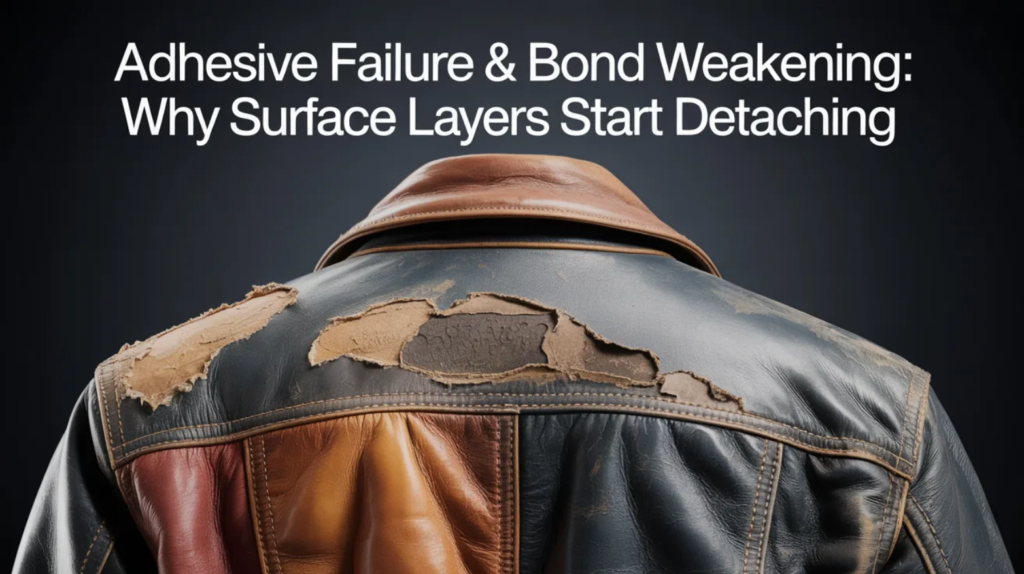
That bond is what keeps the jacket’s finish acting like one smooth, flexible skin. When the bond weakens, the layers stop moving as a unit. The jacket bends, the layers hesitate, and the surface begins to detach.
What “bond weakening” means on a leather jacket
A finished leather jacket typically has multiple surface layers. Even when the leather underneath is real, the outer look usually comes from a built system: a base layer, color layer, and a protective film on top.
Those layers are meant to adhere to each other so they behave like one surface. When that adhesion weakens, the upper layer can separate and peel, especially in high-motion areas.
If you want a clear picture of how the surface is built, the structure described in leather finish layers makes it easier to understand where the bond breaks.
Why bond problems often start near seams, trims, and repaired spots
Bond weakening often shows up in specific zones because those zones are already under stress:
- seams and stitched edges (constant flex and tension)
- collar folds and cuffs (high movement and friction)
- glued trims, piping, patches, and badges (different materials meeting)
- older repairs and touch-ups (multiple coatings layered over time)
These are “boundary zones,” where the surface is most likely to have tiny gaps, contamination, or incompatible layers. Once separation begins, it spreads because the jacket keeps moving in the same way each wear.
The most common causes of adhesive failure and bond weakening
Bond weakening usually happens from a small set of repeatable causes. Most jackets show more than one, but one is usually the main trigger.
1) Residue creates a slippery barrier between layers
Leather products can leave behind residues that feel smooth and protective, but smoothness can also mean “nothing sticks well on top.”
Common residues include:
- wax-heavy conditioners
- silicone sprays and shine products
- oily polishes
- some waterproofing coatings
When residue sits on the surface, any new layer applied later, like a touch-up dye, repair paint, or recoat, may sit on top instead of bonding. Over time, that stacked layer begins to lift, especially in flex points.
This is why a jacket can look “freshly treated” and then start peeling in strips weeks later.
2) Incompatible coatings don’t grip each other
Not all finishes are compatible. A flexible topcoat needs to bond to a color layer that it can move with. When a hard layer sits over a softer layer, movement stress concentrates at the boundary.
That mismatch often creates:
- fine cracking lines first
- then a clean lifting edge
- then sheet-like peeling as the edge spreads
When peeling looks like a clear skin lifting, it often overlaps with the behaviour of topcoat separation, because both failures involve a weak bond line.
3) Heat and humidity weaken bond strength over time
Bond lines are sensitive to environmental cycling. Heat can soften or stress surface films. Humidity can introduce moisture into the finish system and keep it slightly unstable. Over repeated cycles, the adhesive grip between layers can weaken.
That’s why jackets stored in hot closets, left in cars, or worn in heavy sweat conditions can develop lifting around collars, underarms, and cuffs.
If the jacket was also exposed to sunlight and heat repeatedly, the pattern often connects with finish breakdown from heat and sun, because weakened films bond less reliably.
4) Aggressive cleaning strips the “glue-like” stability of the surface
A finished leather surface is not raw leather. It behaves more like a coated material. Strong cleaners can disturb that coating, making it less stable and less able to bond.
Common triggers include:
- alcohol-heavy wipes
- degreasers used for stains
- solvent-based spot cleaners
- abrasive scrubbing with rough cloths
The surface may look fine immediately, then start lifting later as flex points reveal the hidden weakness.
5) Abrasion pulls at the bond line until it separates
Friction doesn’t only wear down the top layer. It can also catch an edge and start lifting it.
Once abrasion creates a tiny separation point, movement keeps pulling at it. Over time, what began as a thin scuff becomes a visible lifted edge.
Abrasion-driven bond failure often appears:
- at shoulders from straps
- at forearms from desk contact
- along zipper lines from repeated pulling and bending
6) Poor original adhesion from manufacturing or finishing
Sometimes the finish system was never strongly bonded. This can happen with certain low-cost finishes or inconsistent production. In those cases, peeling begins earlier and spreads faster because the bond line starts weak.
You often see:
- clean film lifts rather than dusty shedding
- multiple areas peeling without a single friction cause
- peeling that seems “too soon” for the jacket’s age
Bond weakening vs delamination: two different “separations”
Bond weakening usually describes finish layers separating on a leather jacket.
Delamination usually describes a coated material separating from a backing, which is common in PU and bonded leather. If you see fabric backing exposed, the jacket may be behaving more like a composite material than a finish failure, which is why delamination vs surface flaking is the right comparison when separation looks deep.
Signs your jacket is dealing with bond weakening
Bond weakening has a few repeating clues:
- peeling lifts in smooth edges rather than dust
- the peel spreads faster once an edge forms
- peeling clusters around old touch-ups or treated areas
- different sheen appears underneath the lifted film
- separation begins at seams, folds, cuffs, and collar bends
When these signs appear, the jacket’s surface layers are no longer behaving as one unit, which is why the peeling can feel like it has a life of its own.
What makes bond weakening spread quickly
Once separation begins, the jacket’s normal movement becomes the engine that grows it.
The main accelerators are:
- flexing the same crease daily
- rubbing the lifted area against straps or furniture
- picking or pulling at edges
- applying products over a lifted film
- trying to “seal it down” without proper preparation
If you’ve ever watched a small crack grow when you keep bending a piece of plastic, the feeling is similar. The surface layer is stressed at one point, and each bend encourages it to fail a little more.
How this connects back to peeling causes
Bond weakening is one of the most important mechanisms behind peeling because it can appear in different forms:
- it can cause clear film lifting that looks like topcoat separation
- it can cause color layers to lift when repairs don’t bond properly
- it can mimic delamination until you confirm the material type using delamination vs surface flaking
Understanding bond weakening also improves diagnosis on the main hub, because many peeling cases are really “adhesion cases” wearing a “dry leather” disguise.
Conclusion
Adhesive failure and bond weakening happen when a leather jacket’s surface layers stop gripping each other. That grip can weaken from residues that create a slippery barrier, incompatible coatings stacked over time, heat and humidity cycling, harsh cleaning, abrasion stress, or weak original adhesion.
Once the bond line breaks, the surface layers stop moving as one, and peeling becomes easier to trigger and faster to spread, especially around seams, folds, cuffs, and repaired spots. If you’re diagnosing peeling from the start, this mechanism fits naturally into what causes leather jacket peeling, because many peeling patterns begin as a quiet adhesion problem before they become visible surface damage.