A peeling spot is annoying, but a mismatched touch-up can feel worse because your eyes keep snapping back to it. Color repair on a leather jacket isn’t really about finding a “perfect” bottle match. It’s about creating a believable blend that looks right in normal light, from normal distance, while the jacket moves.
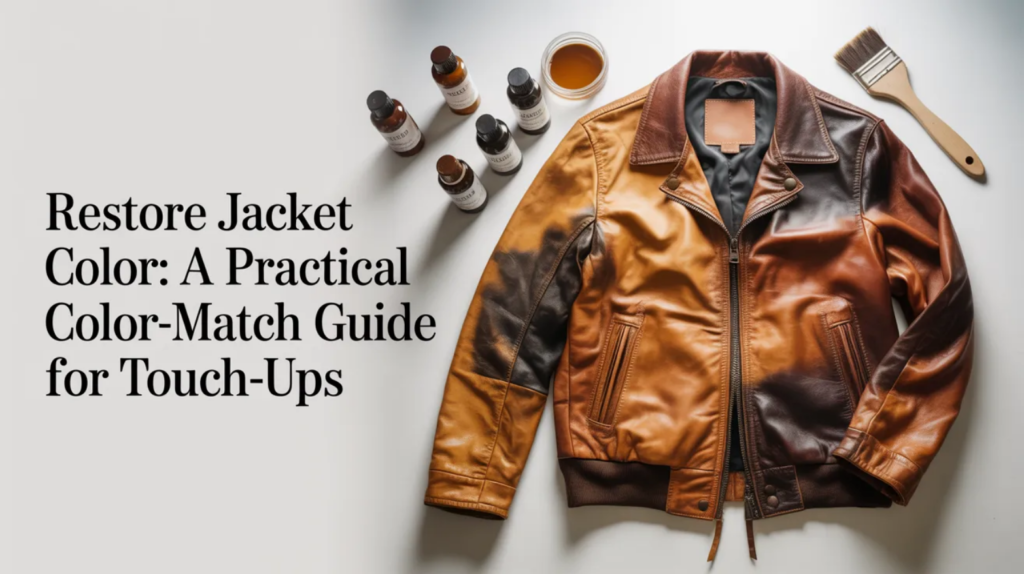
This page focuses on one thing: how to match and blend color for small repairs so the touch-up doesn’t sit on the surface like a sticker.
If the finish is still lifting or the topcoat edge is unstable, color work becomes frustrating fast. In that situation, stabilizing the surface first inside repairing peeling leather jacket finish at home saves time and product.
Why leather touch-ups look “off” (even when the color is close)
A jacket’s color is not just pigment. What you see is the combination of:
- the base color layer
- the topcoat sheen (matte/satin/gloss)
- light reflecting from grain, wear patterns, and oils
So a touch-up can look wrong for three different reasons:
- the shade is off
- the surface is too shiny or too dull
- the edge is too sharp (no blend)
That’s why the practical approach is: match the tone, then match the sheen, then soften the edge.
The “viewing distance rule” (this removes pressure immediately)
Don’t match color with your face two inches from the jacket.
Match it from:
- about arm’s length (how people see it in real life)
- two common lights: daylight and indoor warm light
If it looks right at arm’s length, your repair is already doing its job.
Get the surface ready for color (or the best match won’t stick)
Color needs a stable base. If the edge is still lifting, the best touch-up paint in the world won’t behave.
- If the surface layer is detaching like a film, it helps to first bond the lifting finish back down so the touch-up doesn’t crack along a moving edge.
- If the topcoat is borderline loose, the decision to remove or seal changes everything, and knowing when to remove loose finish versus sealing it keeps your touch-up from sitting on a weak border.
Once the area is stable and clean, color matching becomes much easier and less “random.”
Step 1: Identify your jacket’s color family (so you don’t chase the wrong tone)
Instead of “black” or “brown,” think in families:
For black jackets
- True black (deep, neutral)
- Soft black (slightly greyed)
- Warm black (brownish undertone in light)
- Cool black (blue-ish undertone)
For browns
- Tan/caramel (light, warm)
- Cognac (warm reddish brown)
- Chocolate (deep warm brown)
- Espresso (very dark, sometimes nearly black)
For colored jackets (navy, burgundy, green)
The “color” is often layered over a darker base, so it changes with angle and wear. Expect to match a tone range, not a single shade.
This quick family choice prevents the most common mistake: buying a shade that’s technically close but wrong in undertone.
Step 2: Use the hidden-area check (your jacket already contains the answer)
Look for a less-exposed area that shows the jacket’s “true” color:
- under the collar fold
- inside a pocket flap
- beneath a lapel edge
- inside the hem fold
These areas are less faded and less oiled, so they reveal what you’re trying to recreate.
Step 3: Make a “micro-test” instead of committing to the full spot
Before you touch the repair area, do a small test:
- choose a tiny corner of the damaged zone or a hidden edge
- apply a very thin layer
- let it dry
Wet paint lies. Dry paint tells the truth.
If you do this every time you adjust your mix, you avoid the disaster of repainting the whole area and then realizing it dried two shades darker.
Step 4: Mix for undertone first, then adjust brightness
When a match looks wrong, it’s usually undertone, not darkness.
Here’s a practical way to adjust:
If it looks too grey or “cold”
Add a tiny amount of warm tone (brown/red) to bring life back.
If it looks too orange or too warm
Neutralize it with a small amount of cooler tone.
If it’s the right undertone but too dark
Dilute with a lighter version of the same family (not white, unless your product system supports it cleanly).
If it’s the right undertone but too light
Deepen slowly in drops. Darkness builds faster than you expect.
The best matches happen when you change the mix in tiny steps, not in big jumps.
Step 5: Apply color like makeup, not like wall paint
A jacket moves. Thick paint doesn’t.
A clean touch-up uses:
- thin layers
- soft edges
- gentle build-up
The sponge-dab method (the easiest way to blend)
- put a small amount on a sponge
- dab most of it off
- tap lightly onto the repair
This creates a “grain-like” texture and avoids brush lines.
The feather-out method (so you don’t leave a ring)
Don’t stop your color exactly at the damage border.
Bring it slightly past the edge in a fading way, so the repair dissolves into the surrounding color.
That single habit is what makes a touch-up look natural instead of stamped.
Step 6: Match sheen after color (because sheen can fake color)
Even a good color match will look wrong if sheen is wrong.
- Too glossy makes the area look darker and more “plastic.”
- Too matte makes the area look lighter and dusty.
So after your color dries:
- compare the sheen to the surrounding panel
- adjust with the correct finisher sheen
This is one reason product compatibility matters. If you’re choosing items now, it helps to rely on repair products commonly used for peeling jackets so your color and topcoat behave as one system.
Situations that need a slightly different approach
If the jacket is faded and you’re matching a worn tone
Matching the “original” hidden color can make the repair stand out.
In that case, match to the visible surrounding panel instead, because that’s what your eyes will compare it to.
If you’re touching up near stitching or edges
Edges catch light and show lines easily.
- use painter’s tape if needed
- apply thinner coats than you think you need
- blend outward rather than trying to paint a perfect boundary
If you’re repairing black and it looks “flat”
Black repairs often fail because they look too uniform.
Adding texture through light dabbing and letting the natural grain show keeps black from looking like a painted patch.
Common reasons touch-ups fail (and what to do instead)
“The color is close, but it still looks obvious”
That’s usually a hard edge or wrong sheen.
- soften the blend area
- adjust the topcoat sheen
“It looked perfect wet, but dried wrong”
That’s normal.
- micro-test
- dry fully
- adjust in tiny steps
“The paint cracked later”
That often means coats were too thick or the base edge was still moving.
A stable surface and thin layers keep flexibility.
If your repair is small and mostly flaking rather than deep color loss, handling small flakes with thin rebuilding steps can reduce how much color you need in the first place.
Conclusion
Color restoration on a leather jacket is a blending skill more than a guessing game. The finish looks natural when the surface is stable, the undertone is right, the color is built in thin layers, and the sheen is matched so light reflects the same way across the panel. When you treat the touch-up like a soft transition instead of a painted block, your eyes stop hunting for the repair, and the jacket starts feeling like your jacket again.