Buying products for a peeling leather jacket can feel like standing in front of a wall of bottles that all promise the same thing. The real trick is simpler: choose products that behave like a flexible “finish system.” A jacket bends at elbows, creases at the shoulders, and rubs at cuffs, so anything that dries hard or brittle usually fails again.
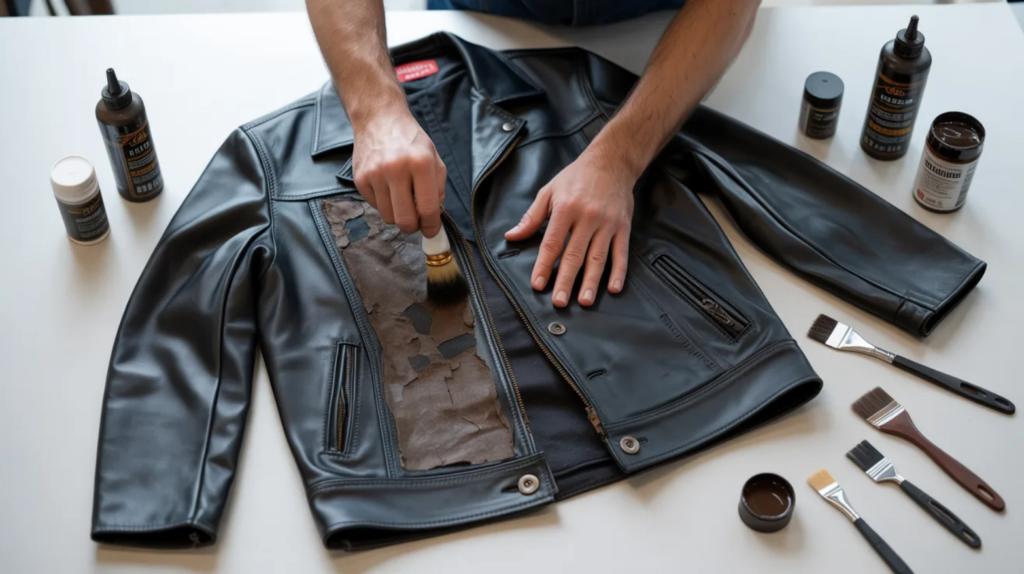
This page helps you pick the right product types (and a few reliable brand families) based on what your jacket is doing: flaking, lifting, losing color, or just needing a protective topcoat. When you want the full workflow these products plug into, the complete process lives in repairing peeling leather jacket finish at home.
The 5 product types that actually matter
Most successful repairs use some combination of these five categories:
- Cleaner
Removes oils and grime so layers bond instead of sliding. - Prep / Deglazer (only when appropriate)
Helps new coatings grip on smooth, factory-finished surfaces. - Adhesive for lifting finish
Bonds a detaching surface back down so the base stops moving. - Color layer (paint/dye/balm)
Rebuilds missing color and blends the repair into the surrounding panel. - Topcoat / Finisher
Seals and protects the work, and controls sheen so the repair doesn’t look “sticker shiny.”
If you’re trying to decide whether you need removal or sealing before you even shop, the choice becomes clearer after seeing how loose topcoat behaves when it should be removed versus sealed.
A smart way to shop: pick a “basket” that matches your damage
Instead of buying everything, match your jacket’s problem to the smallest set that can solve it.
Basket A: “Small flakes + light damage”
Best when you have tiny chips or minor flaking that isn’t lifting in sheets.
What to buy
- Gentle leather cleaner
- Fine sanding pad (for feathering edges)
- Flexible leather color product (only if color is missing)
- Flexible topcoat/finisher (matte/satin/gloss to match)
What this basket prevents
- The repair turning into a thick patch
- New flaking caused by an unprotected color layer
Color matching is where most people overcorrect, so it helps to apply color the way it naturally blends in restoring jacket color with a practical touch-up method.
Basket B: “Surface layer is lifting”
Best when the finish is detaching like a thin film or flap.
What to buy
- Gentle cleaner
- Flexible leather-compatible adhesive (made for leather finishes, not hard-setting household glue)
- Optional: finisher/topcoat for protection after bonding
This basket is about stabilizing movement. A bonded surface behaves. A floating surface keeps peeling.
If you’re dealing with a lifted edge that keeps catching and spreading, re-adhering a detaching finish layer shows the exact kind of bond you’re trying to create, so you don’t end up sealing over a moving base.
Basket C: “Color looks faded or uneven, but the surface is stable”
Best when the jacket isn’t actively peeling much anymore, but repaired spots look dull, lighter, or mismatched.
What to buy
- Cleaner
- Color product suited to your leather type (paint/dye/balm)
- Finisher/topcoat to match sheen and protect
This basket is for “make it look like one jacket again,” not “rebuild the structure.”
What to look for in each category (so you don’t get tricked by labels)
1) Cleaners
Choose: mild leather cleaner or leather-safe soap used gently.
Avoid: harsh degreasers as your first step (they can dry or dull the surface fast).
A simple rule: if a cleaner leaves the surface squeaky and chalky, it may be too aggressive for jacket leather.
2) Prep / Deglazer
Prep products help adhesion on smooth, finished leather, but they can also remove too much if you treat them like a cleaner.
Choose: a leather preparer/deglazer used sparingly on finished leather.
Avoid: using prep as an all-over wipe “just in case.”
When your repair area is small, a light mechanical feather (fine sanding pad) plus cleaning often does more good than aggressive stripping.
3) Adhesives for lifting finish
This is where many repairs fail because people grab the wrong kind of glue.
Choose: flexible adhesives intended for leather/flexible coatings.
Avoid: super glue and rigid epoxies. They set hard, then crack at flex points.
A good adhesive choice stays slightly flexible after curing, so the bond survives bending.
4) Color products: paint vs dye vs balm
Here’s the simplest way to decide:
Leather paint (common for jackets)
- Works well for pigmented/finished jacket surfaces
- Builds coverage in thin layers
- Great for precise touch-ups and blending
Good match when: color is missing in patches and you need controlled coverage.
Leather dye
- Penetrates more than paint on absorbent leathers
- Can be harder to control on factory-finished, sealed surfaces
Good match when: the leather is more absorbent (not heavily sealed) and you’re recoloring more broadly.
Recoloring balm / color refresher
- Often easier for light fading and surface refresh
- Less ideal for sharp chip repairs where you need structured layers
Good match when: the jacket looks tired or faded rather than chipped down to a base layer.
If the touch-up is small and you want it to disappear without a harsh “paint edge,” the blending approach in a practical color-match routine for touch-ups helps more than chasing a “perfect bottle color.”
5) Topcoats and finishers
Topcoat is not optional when you want the repair to last, because it’s the protective film that takes friction and flex.
Choose: flexible finishers in a sheen that matches the jacket (many jackets are satin/matte).
Avoid: hard, glassy sealers meant for rigid surfaces.
Sheen matters more than people think
- Too glossy can make the repaired spot look darker and plastic.
- Too matte can make it look chalky and lighter.
A finisher that matches the surrounding panel often makes an “okay” color match look great.
Brand families that are commonly used for DIY leather finishing
You don’t need one specific brand, but you do want products that are designed to work together.
For flexible paint + finisher systems (popular for DIY)
- Angelus-style leather paints and acrylic finishers (matte/satin/gloss options)
For repair kits that bundle steps
- Colorlock-style kits (cleaning + repair + color + protection)
- Furniture Clinic-style systems (recolor products + finish options)
For prep/deglaze
- Fiebing’s-style deglazer/prep products (used carefully and sparingly on smooth leather)
You can mix brands, but mixing randomly increases the chance of incompatibility (tacky finish, cracking, poor bonding). Staying inside one “system family” often produces fewer surprises.
The “do not buy this for jackets” list (saves you from the common traps)
- Super glue for lifting finish (hard-setting, cracks at bends)
- Generic hardware-store clear coat (often too rigid and too glossy)
- Thick one-coat paints meant for rigid items (jackets need thin flexible layers)
- Heavy oils over repair areas right before recoating (weakens adhesion)
If a product is marketed more like “hard protection” than “flexible finish,” it’s usually a mismatch for jacket movement zones.
Quick product checklist by problem (pick the smallest workable set)
Small flakes (no lifting film)
Cleaner + fine feathering pad + color (if needed) + flexible finisher
Lifting edges or bubbles
Cleaner + flexible adhesive + (later) finisher
Color mismatch after repair
Cleaner + color product + finisher with correct sheen
Repair looks fine but keeps snagging
Finisher/topcoat in thin layers, plus edge smoothing if needed
Conclusion
The best products for leather jacket peeling repair aren’t the ones that sound strongest, they’re the ones that stay flexible and work together like a finish system. A cleaner helps layers bond, a prep product helps when the surface is too sealed to grip, an adhesive stabilizes lifting film, color restores the panel’s tone, and a flexible topcoat protects everything while matching the jacket’s natural sheen. When those pieces fit, the repair feels less like a patch and more like the jacket simply found its balance again.