Two real-leather jackets can age in completely different ways, even if they were bought in the same year and worn the same number of times. One might start looking “peely” around the cuffs and collar, while the other simply looks softer and more worn-in. The reason often comes down to a quiet detail most people never think about: is the leather finished (sealed) or naked (open)?
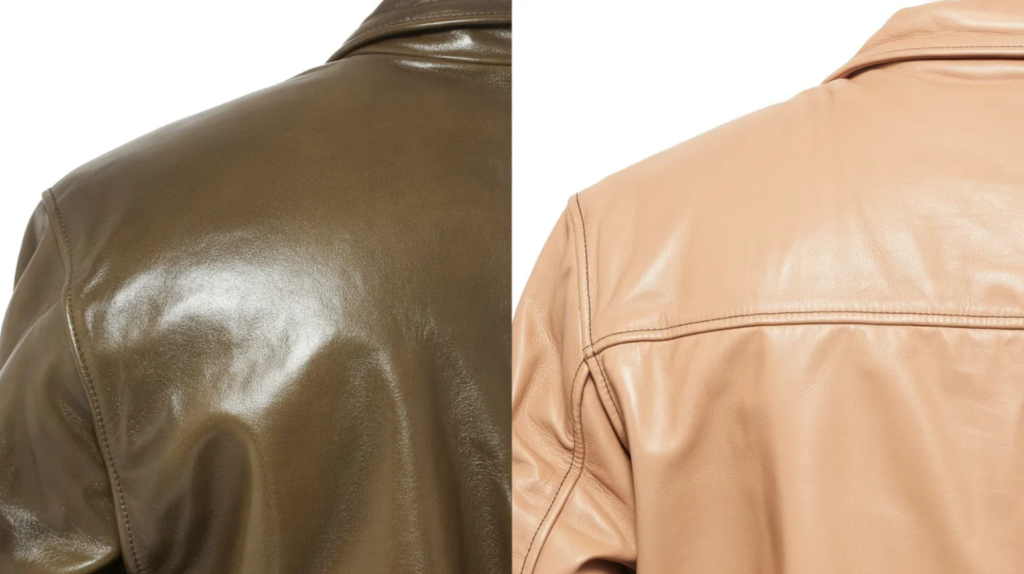
This is not about which one is “better.” It’s about what kind of surface you’re living with, how it reacts to friction and moisture, and what kind of repair actually makes sense when wear starts showing.
If you want the big picture of how different materials peel, this topic fits inside the material-type hub, because a jacket can start peeling in very different ways depending on what it’s made from.
A simple definition (so you can spot it faster)
Finished leather (sealed surface)
Finished leather has a protective layer on top. That layer may include:
- pigment (color coat)
- a clear topcoat (protective seal)
- additives designed for stain resistance and uniform color
This makes the jacket more forgiving in daily life, because the surface is less absorbent and easier to wipe clean.
Naked leather (open surface)
Naked leather is closer to natural leather with minimal surface coating. This includes many aniline and some semi-aniline leathers. The leather is dyed, but the surface remains more open, which is why it feels warm, soft, and “alive.”
That openness also means it shows wear more honestly.
So which one peels more?
Here’s the clean answer:
- Finished leather is more likely to look like it’s peeling, because the topcoat and pigment layer can wear, chip, or rub off in visible patches.
- Naked leather is more likely to look like it’s fading, scuffing, or drying out, rather than peeling in sheets, because there is less of a film-like layer to lift.
So in everyday language, finished leather tends to “peel” more, while naked leather tends to “wear” more.
That difference matters because the repair approach is completely different.
Why finished leather can “peel” even when the leather underneath is fine
Finished leather is often built like a protective system: leather base + color layer + clear topcoat. That topcoat is the shield that takes the daily hits. Over time, friction gradually thins it out.
This is why peeling-like wear appears most often on:
- cuffs
- elbows
- collar edges
- pocket corners
- zipper plackets
When the topcoat starts breaking down, the jacket may show:
- small chips of color
- rough, patchy areas
- dull spots next to shinier spots
- color transfer onto cloth in heavy-contact zones
The important part is this: the leather underneath can still be strong and healthy. It’s the surface system that’s tired.
Why naked leather rarely peels in a film-like way
Naked leather doesn’t have a heavy pigment and topcoat layer to “lift.” Instead, it responds to life by absorbing and changing.
That means naked leather often shows:
- fading in sun-exposed areas
- darkening where oils soak in
- soft scuffs that blend when rubbed
- dryness that becomes visible as dullness or micro-cracking
When naked leather looks like it’s “flaking,” it’s usually the leather surface becoming brittle from dryness or harsh cleaning, not a coating peeling off.
If your jacket’s damage looks like patchy dye loss and abrasion rather than coating chips, it may help to understand why a jacket can start looking “peely” when aniline dye wears away and the surface dries out.
The quickest at-home clues (without overthinking it)
You can often tell finished vs naked leather by noticing how it reacts to touch and light.
Finished leather usually:
- feels smoother and more uniform
- resists small water drops briefly
- looks slightly more “even” in color
- shows wear as edge-chipping or color rub-off
Naked leather usually:
- feels warm and organic, sometimes slightly velvety
- marks more easily with fingernails or light rubbing
- absorbs moisture faster
- shows wear as fading, scuffs, and natural darkening
If you want a step-by-step check that includes visual cues, you can identify your jacket material at home using simple tests before choosing any product.
Which one is easier to repair when it starts looking bad?
This is where it gets practical.
Finished leather is often easier to make look “even” again
Because finished leather has a surface system, repairs often focus on:
- cleaning without stripping the remaining finish
- blending color where pigment has worn thin
- resealing so friction doesn’t keep removing pigment
When done well, finished leather repairs can look surprisingly “factory clean,” especially if damage is mostly on edges and high-contact zones.
Naked leather is easier to improve, but harder to make perfect
Naked leather responds beautifully to gentle care, because the fibers can regain flexibility and richness. But because it absorbs, it can also develop uneven darkening if you apply products too heavily or in the wrong order.
So naked leather can feel “revived,” yet still look naturally aged. For many people, that’s actually the charm.
Why people confuse finished leather peeling with faux or bonded peeling
This confusion is common because the word “peeling” is used for everything.
Faux leather peeling is a film separating from fabric. Bonded leather peeling is a composite layer breaking down. Finished leather peeling is usually a topcoat and pigment wearing away.
If you’re seeing lifting edges and you’re not sure if the jacket is even real leather, it helps to remember that a jacket can start peeling when faux leather’s plastic layer cracks and lifts, while finished leather usually shows more “wear-through” than “film lift.”
The calm choice: what to do next based on your type
If your jacket seems finished:
- avoid harsh solvents
- focus on gentle cleaning + color blending + resealing
- reduce friction on the most worn points
If your jacket seems naked:
- avoid aggressive scrubbing
- focus on gentle cleaning + light, controlled conditioning
- accept that some natural variation is part of the look
And if you’re still not sure, start from the bigger framework because the material-type hub keeps everything aligned with reality. That’s why a jacket can start peeling for completely different reasons depending on the material, and why identifying it first saves time.
Conclusion
Finished leather and naked leather are both real leather, but they age differently because their surfaces are built differently. Finished leather is more likely to “peel” in the sense of topcoat and pigment wear, especially on high-friction zones. Naked leather is less likely to peel like a coating and more likely to show fading, scuffs, and dryness-related surface changes.
Once you know which surface you have, the repair path becomes clearer, and the jacket stops feeling like a mystery problem. It becomes a material with predictable behavior, and that alone makes the whole situation feel easier to handle.