When your jacket starts “peeling,” the biggest mistake is assuming all peeling is the same problem. It isn’t.
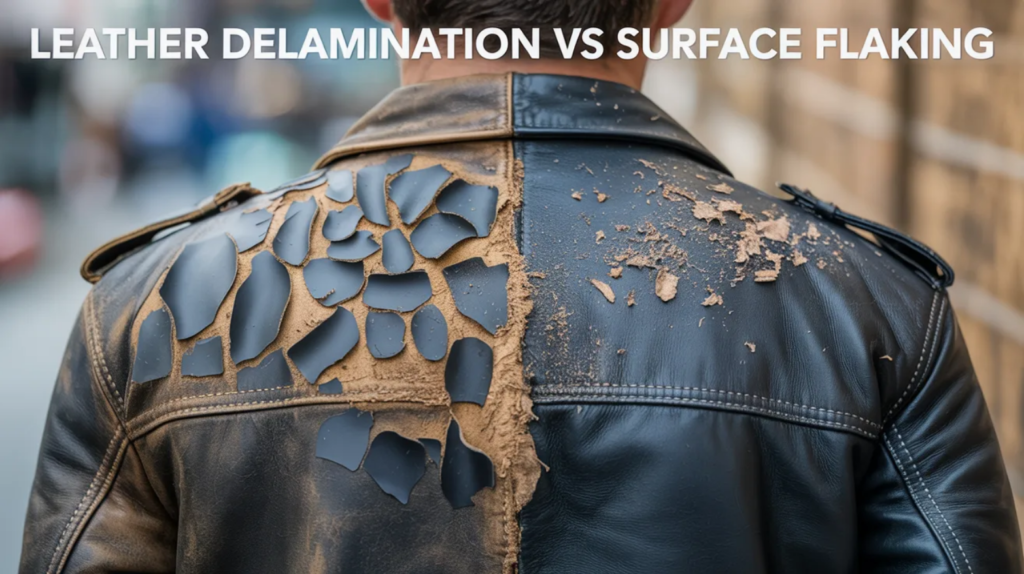
Some jackets peel because the finish is failing on the surface. Other jackets peel because the outer layer is separating from the material underneath. Those two failures look similar in photos, but they behave differently in your hands, and they need different decisions.
This article is your fast, practical way to tell whether you’re dealing with surface flaking or true delamination.
Think of it like this: dust vs skin
If you remember one comparison, make it this one:
- Surface flaking behaves like dry paint turning into dust and chips.
- Delamination behaves like a thin skin lifting off a base.
That simple idea will guide the rest of the diagnosis.
The 60-second test: what do you see underneath?
Instead of staring at the peeled area, focus on what’s revealed.
If you see a smoother surface with a different shine
That usually means a top layer lifted but the material underneath is still part of the same surface system. This often happens when a clear finish lifts away, which matches the behavior described in topcoat separation.
If you see color change but no fabric layer
That often points to a finish wearing through or shedding rather than a full separation of materials. It connects closely with how finish layers work, because you’re seeing different layers of the same finish stack.
If you see a woven fabric, mesh, or “backing cloth”
That’s the strongest signal of delamination. It usually means the jacket is behaving like a layered composite material, not like bare leather with a worn finish.
In plain terms, you’re not just losing “coat.” You’re losing the outer skin of the material.
What surface flaking looks and feels like
Surface flaking is a surface failure. The jacket isn’t separating into two materials; the top finish is breaking down where it sits.
You typically notice:
- small flakes or chips, especially at crease lines
- powdery dust on dark jackets (it can look like tiny crumbs)
- roughness that spreads gradually
- dull patches that appear before any peeling is visible
- “wear” that looks like sanding rather than tearing
Surface flaking often starts in:
- elbows and forearms
- collar edges
- cuffs and pocket rims
- areas rubbed by seat belts or straps
It’s common on genuine leather with pigment finishes, and it can also happen when cleaners weaken the surface film.
What delamination looks and feels like
Delamination is separation. It’s not just the finish failing; it’s the outer layer losing its bond to the base material.
You typically notice:
- peeling that lifts in larger sections
- edges that look like a torn film
- the peel feeling flexible like plastic skin
- a backing layer visible underneath (often woven)
- peeling that spreads fast once an edge forms
Delamination often appears on:
- PU / faux leather jackets
- bonded leather products
- bicast or heavily coated low-cost materials
The biggest clue is the “two-material” feeling: one layer lifts away cleanly from another.
The finger test: does the edge crumble or lift?
Find a tiny damaged area (don’t pick at a big edge). Lightly touch the surface.
- If it crumbles or sheds tiny flakes, you’re likely dealing with surface flaking.
- If it lifts like a film and forms a clean edge, delamination becomes more likely.
A lifting edge can also happen with clear finishes on genuine leather, so if it lifts but you don’t see fabric backing, it may be a finish bond issue like bond weakening rather than delamination of the base material.
Where the damage starts can hint at the type
Location won’t confirm the diagnosis by itself, but it can help.
Surface flaking often starts at stress + friction zones
- elbow bends
- cuff rims
- collar fold lines
- forearms (desk contact)
These zones break finishes slowly because friction and flexing keep “working” the same area.
Delamination often starts where the coating is most stressed by environment
- shoulder tops exposed to sun
- panels that heat up in cars
- areas that stay damp with sweat
- folds that trap humidity
That’s why delamination sometimes shows up after a storage season or after repeated hot weather wear, and why heat and sun finish breakdown is often part of the story, even when the jacket is not genuine leather.
Why the difference matters before you try to fix it
This part saves you money and disappointment.
If it’s surface flaking
A surface flaking jacket often benefits from:
- gentle cleaning
- stabilizing the surface
- re-coloring or recoating the affected zone (when appropriate)
Because the base is still structurally intact, the repair has something stable to hold onto.
If it’s delamination
Delamination is harder because the base material is separating. In that case:
- repairs are usually cosmetic
- patches may not last long if the surrounding coating continues to peel
- the best “fix” may be slowing spread and managing expectations
Trying to treat delamination like dry leather is one of the most common reasons people feel like “nothing works.”
A simple decision map you can trust
If you want a calm, reliable way to decide, use this:
- Does it shed in flakes or dust? → surface flaking is likely.
- Does it peel in sheets and show backing? → delamination is likely.
- Does it lift like film but shows no backing? → a layer bond issue is likely, which fits topcoat lifting or bond weakening.
This is also why the main hub page exists: leather jacket peeling causes. It helps you place your jacket in the right category before you jump into solutions.
What to do next once you confirm which one it is
If you confirmed surface flaking, it helps to understand which layer is failing inside the finish stack, so revisiting finish layers gives you a clearer picture of what’s breaking down.
If you confirmed delamination, focus on prevention and containment, especially reducing heat stress and friction, because delamination spreads once an edge forms.
And if you’re stuck between the two, use the “what’s underneath” rule again. The material under the peel almost always tells the truth.
Conclusion
Surface flaking and delamination are both called “peeling,” but they’re not the same failure.
Surface flaking is a finish breaking down on the surface, usually showing dust-like shedding, small chips, and gradual wear. Delamination is a separation of layers, often seen as sheet-like peeling with a backing layer exposed underneath.
Once you identify which one your jacket is showing, the rest becomes easier: you stop using the wrong fixes, you understand why the damage behaves the way it does, and you can make smarter choices based on the reality of the material in front of you.