The hard truth about leather repair is that “looks good today” and “still looks good after 30 wears” are two different outcomes. Repair kits can improve small areas fast, but professional restoration usually wins on longevity because specialists control surface prep, color blending, and the final protective finish that has to flex with the jacket. This guide helps you choose based on long-term results, not first-day shine.
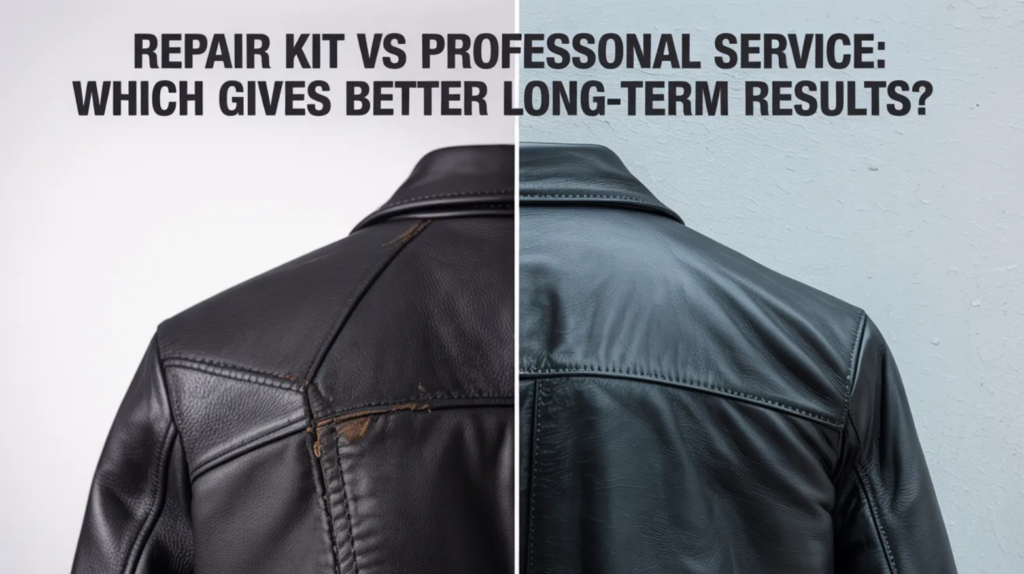
What “long-term results” actually means for a leather jacket
A leather jacket doesn’t sit still. It bends at the elbows, stretches across the shoulders, rubs at cuffs, and gets exposed to heat, humidity, rain droplets, and skin oils. Long-term results mean the repair stays stable through that movement.
In practical terms, a repair lasts when it:
- Bonds evenly to the surface (no lifting or flaking)
- Flexes without cracking at crease lines
- Keeps color consistent in daylight (no obvious patches)
- Doesn’t feel stiff or sticky after a few wears
- Handles friction at cuffs, collar edges, and pocket corners
Most “failed repairs” fail for one reason: the surface underneath wasn’t prepared to hold the new layer.
Why repair kits can work surprisingly well
Repair kits are not automatically bad. They’re just limited by what you can realistically do at home.
A kit is often the right choice when:
- The damage is small and localized (one scuff zone, one tiny peeling edge)
- The jacket is not a daily-wear workhorse
- You’re okay with “better” rather than “invisible”
- You can do careful prep and patient drying time
DIY can feel satisfying because you’re fixing the one spot that keeps bothering you. And when the surface is stable, a small touch-up can hold up longer than people expect.
If you’re thinking about cost first (which is normal), people often choose a kit when the quote jumps because the jacket needs surface prep, blending, and sealing rather than a simple clean.
Where repair kits usually break down over time
Kits struggle most when the problem is not “a mark” but “a failing surface.”
Long-term issues often show up as:
- Edge re-peeling after the jacket bends and the repaired area flexes
- Cracking at crease lines because the repair layer is too thick or too rigid
- Color mismatch that becomes obvious in daylight
- Patchy sheen where the repaired area reflects light differently
- Sticky feel when too much product sits on the surface instead of bonding into it
Here’s the big one: if the original finish is unstable, the new layer is only as strong as the weakest surface underneath it. That’s why a kit can look perfect on day one and disappoint on week three.
Why professional restoration usually lasts longer
Professionals don’t just “cover” damage. They manage the surface so the repair becomes part of the jacket again.
A specialist typically wins long-term because they can:
- Strip or stabilize unstable finish where needed
- Smooth the surface without leaving a hard edge
- Match color in layers so it blends naturally
- Apply a flexible topcoat designed to move with wear
- Control drying and curing conditions so the finish sets correctly
In other words, a pro isn’t only improving appearance. They’re increasing the chance the repair survives real-life movement.
This matters most for peeling jackets, because peeling often needs controlled rebuilding rather than a quick cosmetic layer.
A simple decision matrix (choose your lane)
Use these quick comparisons to decide:
Choose a repair kit when…
- The peeling/scuffing is small and mostly on the edges
- The jacket is mid-priced or easily replaceable
- You can accept a “visible but improved” outcome
- You’re willing to redo the spot later if needed
Choose professional service when…
- The jacket is expensive or sentimental
- Peeling is spreading or appears on panels, not just edges
- You need a durable result for frequent wear
- You want blending that looks natural in daylight
- Past DIY attempts already left uneven layers
If you’re already leaning toward professional work, the safest move is choosing someone who won’t overpromise, because long-term success depends heavily on process. That’s why repairs hold up better when you work with a specialist who explains prep steps and sets realistic expectations.
“But I want the cheapest long-term option” (the real answer)
The cheapest long-term option is the one you don’t have to pay for twice.
A kit can be cheapest when it genuinely solves a small problem.
A professional can be cheapest when the alternative is repeated DIY layers that keep failing.
A useful way to think about it is this:
- If you’d be annoyed redoing it, you’re not buying a repair, you’re buying durability.
- If you’d enjoy touching it up again later, you’re buying improvement at a lower cost.
If you do DIY, do these 5 things to improve durability
This section is for you if you’re still leaning kit but want the best chance of success.
- Clean the area properly first
Oils and residue reduce bonding. Gentle cleaning and full drying matter more than people think. - Feather the edges, don’t create a “patch line”
Hard edges are where peeling restarts. - Use thin layers
Thick layers crack. Thin layers flex. - Let it cure, not just dry
Dry-to-touch is not the same as fully set. - Avoid heavy friction for a while
Cuffs and pocket edges get rubbed constantly. Give it time before daily wear.
These steps won’t turn a kit into a professional finish, but they can stop the common failure patterns.
If you’re undecided, use this one-question test
Ask yourself:
“If the repair looks good but starts cracking again after a few weeks, will I regret not going professional?”
- If the answer is yes, go professional.
- If the answer is no, try the kit carefully.
That single question prevents most frustration.
Conclusion
Repair kits can improve small scuffs and limited peeling, especially when the surface underneath is stable and you apply thin, patient layers. Professional restoration usually delivers better long-term results because a specialist controls surface preparation, color blending, and the protective finish that has to flex with the jacket through daily movement. When the jacket is expensive, peeling is spreading, or you need durability you can trust, professional work is often the decision that saves you time, stress, and repeat fixes.