Professional leather jacket restoration costs more than a basic clean because the work is mostly preparation and precision. A specialist has to remove oils and old residue, stabilize weak areas, match color, and seal the finish so it flexes with the jacket instead of cracking again. This page breaks down what drives the price, which jobs sit in higher cost bands, and how to judge whether the quote is fair.
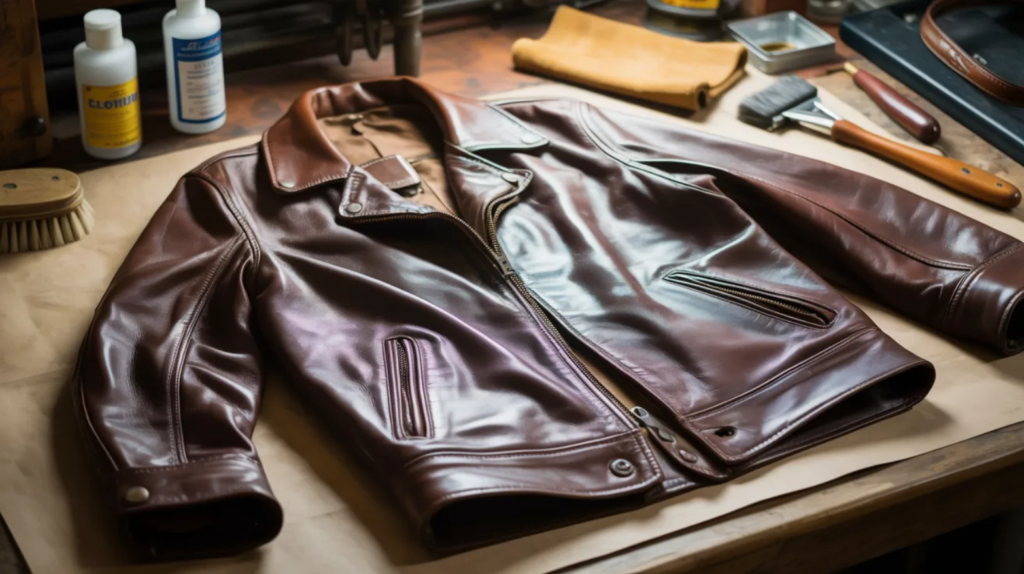
Why restoration pricing varies so much
Two jackets can look equally “worn” from a distance and still get very different quotes. That difference usually comes from what’s happening under the surface, because leather doesn’t fail in one simple way.
A jacket with stable leather and light scuffs is predictable to restore. A jacket with peeling, flaking, sticky patches, or old DIY layers is unpredictable, because the surface may not bond evenly unless it is rebuilt first. That hidden prep time is a major reason pricing spreads widely.
What you are actually paying for
Most professional quotes are built from labor time plus material complexity. The bigger the risk of failure, the more careful the process has to be.
1) Cleaning and decontamination
Leather collects oils from skin, smoke odors, dust, and old product build-up. When those sit in the pores, color work becomes unreliable. A restorer charges for safe cleaning because harsh cleaners can dry leather out and make it crack faster.
2) Surface preparation
Surface prep is the “invisible work” that determines whether the result lasts. When the surface is stable, prep is simpler. When the surface is unstable, prep becomes the job.
This is also why restoration pricing rises when a jacket looks fine at first but fails again after flexing and wear, because short-term appearance is not the same as long-term durability.
3) Color matching and blending
Color work is rarely a single coat. A professional blends color in layers so repairs don’t look like patches. This becomes harder when the jacket has a faded “vintage” tone, uneven wear, or multiple different panels that reflect light differently.
4) Finish and sealing
Even perfect color work can fail if the finish is wrong. A professional finish needs to be flexible, even, and resistant to scuffing. Sealing is what helps the jacket hold up against everyday friction at cuffs, elbows, shoulders, and collar edges.
Typical restoration cost bands (what most quotes are based on)
Prices vary by city and shop, but most restoration work falls into a few predictable groups.
Band A: Professional clean and condition
This is the most affordable band and often delivers the biggest “before and after” surprise when the jacket is mainly dull, dry, or dirty rather than damaged. It’s ideal when the leather feels stiff, looks tired, or smells like storage.
Band B: Scuff repair and small color touch-ups
This band covers edge wear, rub marks, light scratches, and small faded zones. The cost depends on how many areas need blending and how hard the color is to match.
Band C: Full recolor or color correction
A full recolor costs more because the work has to look consistent across multiple panels. This is often chosen when cleaning isn’t enough and the jacket still looks uneven under daylight.
Band D: Peeling finish repair and surface rebuilding
Peeling is usually the most expensive category because it forces extra steps. A restorer may need to remove unstable material, smooth the surface, rebuild layers, then recolor and reseal.
This is why a restoration quote increases when you need a specialist who can explain their prep steps and set realistic expectations, because peeling repairs fail most often when the process is rushed or oversold.
Band E: Structural repairs
Zippers, torn linings, seam repairs, and panel damage are priced by time, construction complexity, and parts. A jacket can look “not too bad” and still be costly if the build is complex or the repair sits in a high-stress area.
Hidden factors that can add to the price
Even with a fair base quote, a few extras can change what you pay.
- Shipping or courier fees if you’re using a shop outside your city
- Express turnaround fees if you need it quickly
- Aftercare products if the restorer recommends a specific conditioner or protective finish
These aren’t always required, but they matter because the wrong aftercare can shorten the life of the restoration.
What a fair quote sounds like
A fair quote usually includes clear language about what the shop will do and what they will not promise.
Good quotes tend to:
- Describe the condition and the steps they’ll take
- Mention blending, prep, and sealing rather than just “paint”
- Set expectations about what will improve and what may still show slightly
Suspicious quotes tend to:
- Promise “factory new” results for heavy peeling without inspection
- Avoid explaining prep and jump straight to coloring
- Give a cheap number with vague language that hides risk
How to get a more accurate quote quickly
You’ll get better estimates when you provide:
- Natural-light photos (front, back, sleeves, collar)
- Close-ups of peeling, cracks, scuffs, and worn edges
- A short note about what you want (touch-up vs full refresh)
- Any past DIY attempts (kits, sprays, paints), because this changes prep time
When a restorer understands the surface condition, the quote becomes more precise and usually more honest.
When paying more is actually smarter
Cheapest is not always cheapest. A finish that looks great for two weeks and fails after flexing can cost you twice.
Paying more often makes sense when:
- The jacket is expensive or sentimental
- Peeling is present and needs surface rebuilding
- Color matching must be subtle and natural
- You plan to wear it regularly
In those cases, quality prep and sealing are what protect your money.
Conclusion
Professional leather jacket restoration cost is driven mainly by labor and surface difficulty. Cleaning and conditioning are usually the lowest band, color correction raises time and precision, and peeling repairs sit at the high end because the surface must be rebuilt before it can be recolored and sealed. When the underlying leather is still strong, paying for professional restoration can bring back the feel and confidence of wearing the jacket again, instead of leaving it hanging in the closet.