Topcoat peeling creates a frustrating kind of damage because it looks bigger than it is. A tiny edge lifts, catches on your sleeve, and suddenly a clean jacket panel has a ragged “map” of missing finish. The hardest part is not the tools or the products, it’s the decision that comes first:
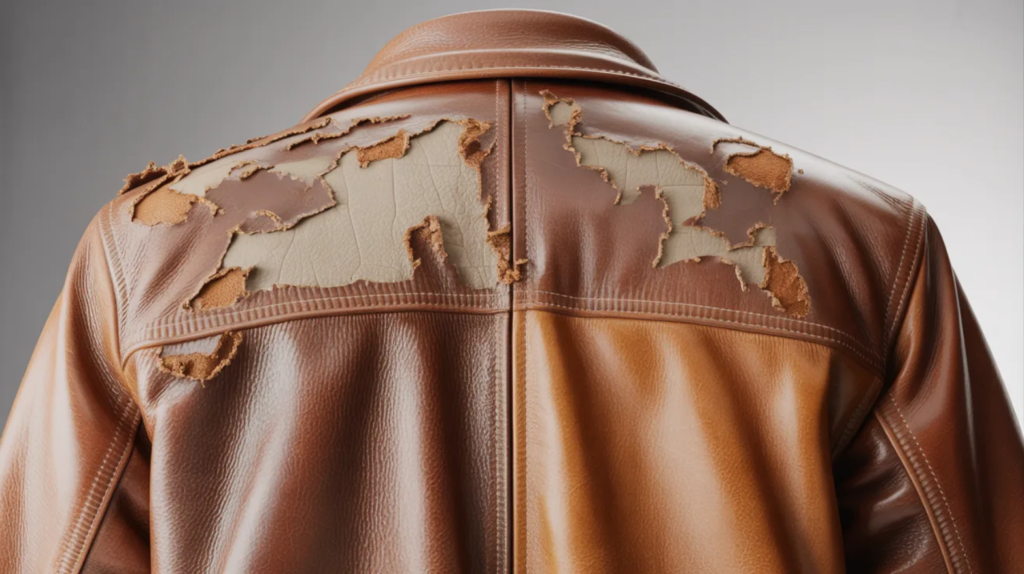
Should you remove the loose topcoat… or can you seal it down and move on?
This article gives you a clear way to decide, using what the surface is already telling you. If you also want the full repair sequence that comes after this decision (cleaning, blending, color, and finishing), it sits inside repairing peeling leather jacket finish at home.
The key idea: stable edges behave, unstable edges travel
A peeling topcoat has one defining characteristic: it either stays put or it keeps migrating.
- A stable edge feels anchored and doesn’t widen when touched.
- An unstable edge lifts farther when rubbed, flexed, or lightly pressed.
Your decision is simply:
build over stability or remove instability.
A simple test that tells you what to do (no guessing)
Use clean, dry fingers or a cotton swab and try three mini-tests on the peeling border.
Test 1: The “wipe test”
Lightly wipe across the edge with a dry microfiber cloth.
- If nothing changes, the edge is likely stable.
- If the edge curls more or releases new flakes, the edge is unstable.
Test 2: The “tap-and-flex test”
Gently tap the peeling border, then bend the leather slightly (don’t force it).
- If the edge stays flat, sealing may work.
- If it lifts higher or creates a new lift line, removal is safer.
Test 3: The “shape test”
Look at the peel pattern.
- Small, isolated chips often behave like a localized issue.
- Long, thin peeling lines usually indicate a failure path that keeps extending.
When two or more tests suggest instability, removing what’s loose prevents the problem from creeping outward under a new layer.
When removing loose topcoat is the better choice
Removal is usually the correct move when the surface has already “decided” it will not hold.
Choose removal when:
The edge keeps lifting when touched
If a gentle wipe enlarges it, sealing over it often traps failure underneath. That trapped edge becomes a hinge that peels later in a bigger sheet.
The lifted area feels crunchy, brittle, or powdery
A topcoat that has become brittle isn’t a reliable base. Sealing brittle material tends to crack, then peel again.
The peeling line follows a flex zone
Elbows, cuffs, shoulders, and pocket openings flex constantly. A borderline edge that might survive on a flat panel often fails quickly on a bend line.
The topcoat is separating as a “film”
When the topcoat lifts like a thin clear skin rather than chipping, bonding stability matters more than cosmetics. In that case, the surface becomes safer to work with after re-adhering the detaching layer or removing the unstable section cleanly.
How to remove loose topcoat without widening the damage
Removal should be controlled and minimal. The goal is not to strip the whole panel. The goal is to stop at the last point where the finish is truly bonded.
1) Clean first
A clean surface shows you what’s actually loose instead of what’s just dirty.
2) Lift only what releases easily
Use your fingertip or a cloth and remove pieces that come off with almost no resistance.
If you have to “pull,” you’re probably removing finish that is still bonded.
3) Feather the edge
A harsh ridge is what makes repairs look obvious.
Use a fine sanding pad and soften the transition until it feels smoother to the touch.
4) Rebuild in thin layers
Once the border is stable and smooth, the surface becomes much easier to repair in a clean sequence. If the damage you’re dealing with is small flakes and light loss, repairing small peeling flakes in thin layers helps you rebuild without creating a thick patch.
When sealing over peeling topcoat can work
Sealing is sometimes the right move, but only when the edge is stable enough to behave like part of the surface again.
Sealing can work when:
The peeling is tiny and does not expand when wiped
If the border does not move during the tests above, it often means the failure is localized and already “done.” A flexible topcoat can protect the area and stop snagging.
The jacket panel is mostly flat and low-flex
A small chip on a flatter area sometimes accepts sealing better than an edge on the cuff or elbow.
The edge is thin and already lying close to the surface
If it isn’t curled up, it’s easier to lock down with minimal buildup.
How to seal a stable topcoat edge so it doesn’t look shiny or thick
Sealing is not “painting over damage.” It’s creating a new protective film that blends.
1) Clean and dry
Sealing over oils creates early failure and unwanted shine.
2) Use thin topcoat layers
A thick coat creates a ridge and can crack. Thin coats flex better and blend more naturally.
3) Extend slightly beyond the edge
This helps the sheen transition smoothly. A seal line that stops exactly on the border can create a visible “ring.”
4) Match the sheen
Many jackets look satin or matte. A glossy topcoat can make a repair look like a sticker even if the edge is stable.
If you want compatible options for flexible finishing, best products for peeling jacket repairs can help you avoid mixes that dry too hard or too shiny.
The most common “wrong decision” and how it shows up later
Sealing over an unstable edge
It usually looks good for a short time. Then:
- the edge lifts again,
- the new layer lifts with it,
- the peel area grows larger.
The problem isn’t the topcoat you applied, it’s that the base was still moving.
Removing too far past what’s loose
This creates a bigger repair area than necessary. You’ll spend more time color matching and blending.
Controlled removal stays small. It ends where the finish is truly bonded.
If you’re stuck, choose the option that creates stability
When it’s genuinely unclear, stability wins.
- If it behaves like it’s anchored, sealing is reasonable.
- If it behaves like it’s traveling, removal prevents a larger failure later.
Once the surface is stable, the rest of the repair becomes predictable, and it fits smoothly into the full at-home peeling finish repair process.
Conclusion
Topcoat peeling is less about “covering the spot” and more about choosing whether the edge can be trusted. A stable edge can be protected and blended so it stops snagging and stays quiet. An unstable edge should be removed back to the last bonded point, then rebuilt so the new layers sit on something that actually holds. When you make that decision based on how the finish behaves, not how it looks in the moment, the repair stops being a temporary patch and starts acting like a finish again.