Bonded leather has a painful way of disappointing people because it often looks “real enough” at first. Then one day the surface starts flaking, the corners begin shedding, and flex points split like the jacket is made of dried paint. If you’ve reached that stage, you’re not dealing with simple dryness or a cosmetic scuff. You’re dealing with a material that is built like a composite, and composites fail differently than full-grain hides.
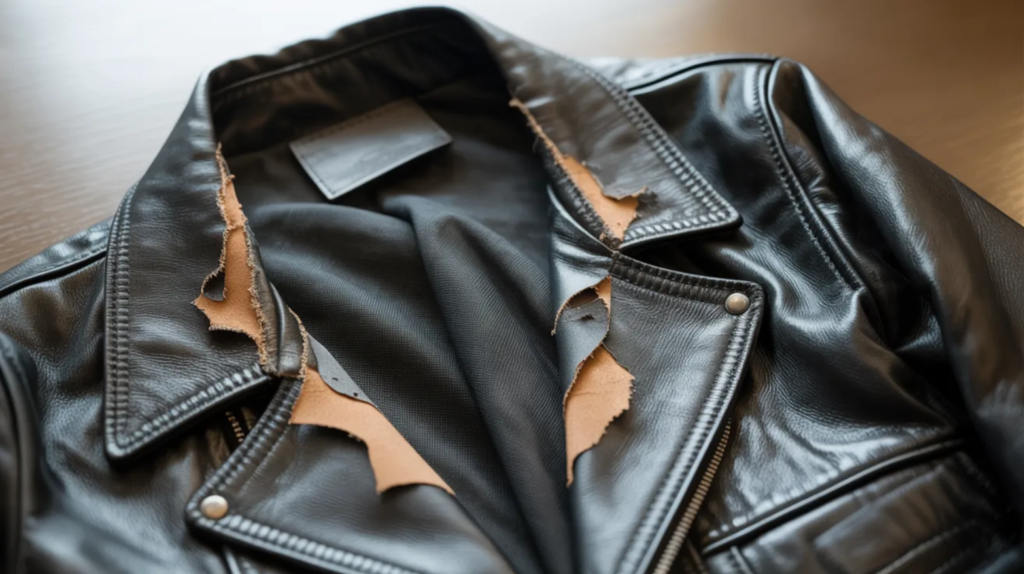
If you’re still deciding whether your jacket is bonded, faux, or real leather, it helps to start from the material-type hub because a jacket can start peeling for completely different reasons depending on what it’s made from.
What bonded leather actually is (in plain terms)
Bonded leather is not a single continuous hide. It’s usually made from:
- Shredded leather fibers (scraps)
- A binder (glue-like polymer)
- A surface coating (often polyurethane) designed to look like leather grain
That structure matters because the jacket’s “skin” is partly a coating, and the layer underneath is not a full hide with long fibers. It’s more like pressed material. When it flexes repeatedly, the surface coating can fracture, and the composite underneath can crumble or separate.
This is why bonded leather often fails in bigger, uglier patches than real leather.
Why bonded leather peels, then splits
Bonded leather tends to follow a predictable timeline. Knowing that timeline helps you choose a long-term option instead of chasing short-term fixes.
Stage 1: Micro-cracking at flex points
The surface coating loses flexibility. Creases start to look sharp, and tiny cracks form where the jacket bends most (elbows, shoulders, cuffs, waistline).
Stage 2: Flaking and shedding
Those cracks widen, and the coating begins to lift in small islands. You may notice flakes on your shirt, your car seat, or the floor.
Stage 3: Peeling and edge lift
Once sections lift, friction catches the edges. Peeling spreads outward, and the jacket starts to look like it’s “scaling.”
Stage 4: Splitting
As the composite weakens, the material loses tensile strength. That’s when seams stress harder, panels thin out, and splits appear around repeated bend lines.
This progression feels sudden, but it’s usually been happening quietly for months.
The key difference: bonded leather cannot be “fed” back to health
Real leather responds to conditioning because oils can migrate into the fiber structure and improve flexibility. Bonded leather doesn’t have the same continuous fiber network. Once the binder starts breaking down, adding oils cannot rebuild the composite. At best, you might change how it looks for a short time. You won’t restore the original structure.
This is where people get trapped: they keep applying more product, hoping for the “one” that finally works. But the failure is structural, not just surface dryness.
If your jacket’s surface is cracking like a film and you’re unsure whether it’s bonded or faux, it helps to know that a jacket can start cracking or peeling when faux leather’s plastic layer loses flexibility, while bonded leather often fails with a more crumbly, patchy breakdown underneath.
How to tell bonded leather from faux leather (the easiest clues)
Bonded leather and faux leather can look similar when they peel, but the feel and the “under-layer” clues are different.
Bonded leather often shows:
- A more paper-like, crumbly texture under the peeled area
- Patchy shedding that looks like compressed dust or fiber fragments
- A “thin skin” coating that breaks into irregular islands
Faux leather often shows:
- A fabric backing revealed clearly
- A cleaner film layer that lifts like plastic
- Cracks that look more like broken paint lines than crumbling composite
If you want a safe confirmation before you spend on repair products, you can identify your jacket material at home using simple tests and visual clues.
What repairs are actually worth attempting (and what to skip)
With bonded leather, the goal isn’t “restoration.” The goal is control: reduce ugly shedding, stop edges catching, and decide whether you’re patching for occasional wear or trying to keep it presentable long enough to replace it.
Worth attempting (small to moderate damage)
- Remove loose flakes carefully so they don’t keep tearing larger patches
- Stabilize edges so peeling doesn’t spread as fast
- Cosmetic patching on small zones (collar edges, cuffs, corners)
- Protecting high-friction areas so the jacket doesn’t deteriorate rapidly
This can work when the jacket is still mostly intact and you’re dealing with isolated failures.
Usually not worth it (widespread damage)
- Thick “repaint the whole panel” approaches
- Heavy conditioners meant for real leather
- Expensive restoration kits that promise permanent results
- Repeated patching in multiple large panels
When bonded leather is failing across multiple panels, repairs become a cycle: fix one spot, another starts peeling, then another.
Long-term options that make sense (choose your path)
Here’s a clearer way to decide what to do, depending on your goal and your jacket’s condition.
Option A: Wear it gently and accept the “patina of decline”
If the jacket is mainly for occasional use and the damage is mild, the best plan is often:
- stabilize small edges
- reduce friction
- store it cool and dry
- avoid heat exposure
This keeps it wearable longer, even if it won’t look perfect.
Option B: Convert it into a “presentable for outings” jacket (targeted patching)
If you want it to look decent from a distance:
- patch only the visible zones
- keep repairs flexible
- don’t chase perfection on hidden areas
This is surprisingly effective when you focus on what people actually see.
Option C: Replace it, but keep the style (the least stressful solution)
If peeling is happening on large panels, replacement often becomes the most economical choice. The trick is not to replace it with the same problem again. If you love the look, choose:
- real leather (with a protective finish if you want easier maintenance)
- higher-quality faux leather with better construction (if you’re avoiding animal products)
- a jacket with reinforced flex zones and better stitching
If you’re comparing real leather finishes and want to avoid a jacket that “seems like it peels easily,” it helps to understand how a jacket can wear differently depending on whether it has a protective finish or a more open surface.
How to slow bonded leather breakdown (even if you’re not repairing)
Even if you don’t patch anything, you can slow how fast bonded leather falls apart:
- Keep it away from heat sources (heaters, hot cars, direct sunlight)
- Avoid high-friction wear (heavy backpack straps, rough seat belts)
- Store it hanging with space so it isn’t crushed and creased
- Don’t soak it or over-clean it
- If it’s already shedding, handle it gently so the surface doesn’t lift further
These steps won’t reverse failure, but they can extend the “wearable window.”
Conclusion
Bonded leather peels and splits because it is a composite material: a coated surface over bonded fibers held together by binders. When that structure starts breaking down, the jacket’s surface doesn’t just scuff, it flakes, lifts, and spreads in patches, especially at flex points.
The most realistic approach is to treat bonded leather repairs as short-term control: stabilize edges, patch only what matters visually, and decide early whether you’re keeping it for occasional wear or replacing it for peace of mind. Once you choose a long-term path, the problem becomes calmer, because you’re no longer fighting a material that cannot truly be restored.