Faux leather usually fails in one of two ways, and the difference matters more than the damage looks. Cracking means the surface film is becoming brittle and splitting like dry paint. Peeling means that film is lifting away from the fabric underneath. Once you know which one you’re seeing, you can stop experimenting and choose a fix that matches the material’s reality.
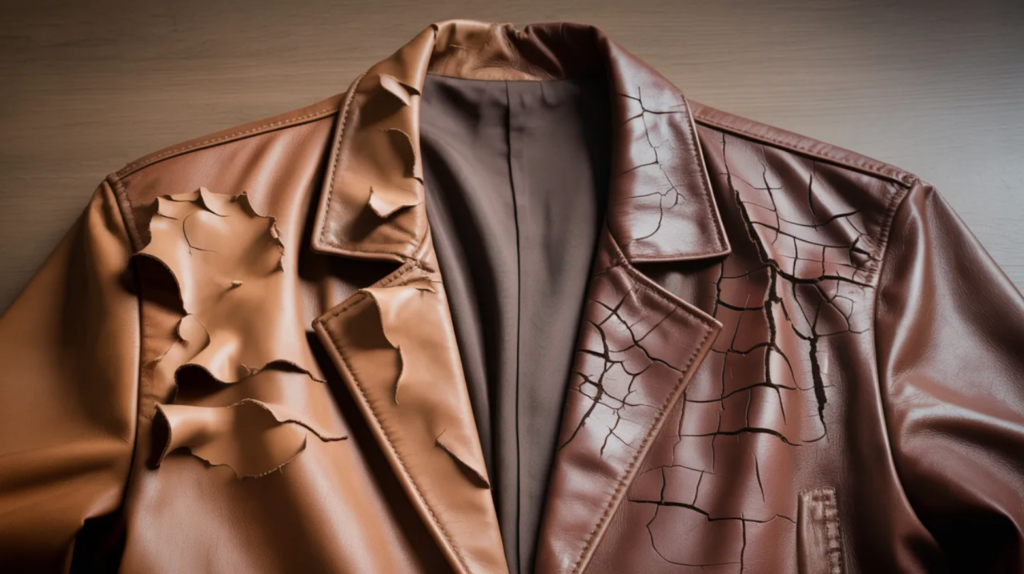
If you’re still unsure whether your jacket is faux, real, or bonded, this is exactly where the material-type hub helps, because a jacket can start peeling in very different ways depending on what it’s made from.
The quick “which one is it?” check (no guesswork)
Look closely at one damaged spot and answer these:
- Do you see thin lines that spread when you bend the jacket?
That’s usually cracking. - Can you lift an edge like a sticker or scrape off a “skin” with a fingernail?
That’s usually peeling (delamination). - Does the damaged area feel rough but still attached, like a dry surface?
That leans toward cracking. - Does the damaged area reveal a fuzzy fabric backing underneath?
That strongly points to peeling.
If you want extra confidence before you treat anything, you can confirm the material using simple at-home tests and visual clues without risking the jacket.
Why faux leather cracks first, then peels later
Faux leather is typically a fabric base with a plastic surface layer. That surface has to flex every time your elbow bends, your shoulder moves, or you sit down. Over time, the plastic loses elasticity, especially when it experiences heat, humidity swings, and repeated friction.
Cracking often appears first because the surface film becomes stiff. Once those cracks widen, the edges catch on clothing and bags. That mechanical stress pulls at the surface layer until sections start lifting, and that’s when peeling begins.
In other words, peeling is often the “second stage” after cracking has weakened the surface.
What you can realistically fix
If it’s mostly cracking (surface still attached)
Cracking is sometimes stabilizable when the surface layer is still bonded to the fabric. The goal is not to “heal” plastic back into one smooth sheet. The goal is to reduce how fast the cracks spread and make the jacket look decent again from normal viewing distance.
What tends to be realistic:
- Cosmetic smoothing for small cracks so they don’t look bright or chalky
- Flexible touch-up on high-visibility zones like collar edges or sleeve creases
- Preventing further cracking by reducing heat exposure and harsh cleaning
A faux leather jacket with light cracking can often stay wearable if you treat it gently and accept a “better, not perfect” result.
If it’s peeling (surface lifting or shedding)
Peeling is different because the surface layer is separating from the backing. Once that bond is failing, no conditioner can reattach it in a durable way. You can sometimes make it look better in small areas, but you can’t restore the original factory lamination.
What tends to be realistic:
- Small patch repairs where the peeling is limited to an edge or corner
- Trimming loose flakes to stop them catching and tearing wider
- Edge sealing so lifting doesn’t travel across a panel
When peeling has spread across large sections, the honest answer is that you’re managing decline, not reversing it.
What you can’t fix (and how to spot it early)
Some faux leather damage is basically a one-way slide. The earlier you recognize it, the less money you waste on “miracle” products.
Signs the jacket is past meaningful repair:
- Peeling appears on multiple panels, not just one edge
- The surface layer comes off in wide sheets
- New peeling starts soon after you patch one area
- The jacket leaves flakes on your clothes after wearing it
At that point, even a neat-looking patch is usually a temporary cosmetic cover.
If your faux jacket is peeling in big patches and you’re wondering whether it might actually be bonded leather instead, it helps to understand why jackets can start peeling when bonded leather breaks down into flakes and splits, because the “sheet lifting” look can feel similar even though the material underneath is different.
The biggest mistake people make with faux leather
The most common mistake is treating faux leather like real leather.
Real leather benefits from conditioning because oils can move into the hide and improve flexibility. Faux leather is a plastic film over fabric, so most leather conditioners sit on top, attract dust, and sometimes make peeling worse by softening adhesive edges unevenly.
Another mistake is aggressive cleaning. Scrubbing doesn’t “save” faux leather. It often speeds up surface failure by lifting already-weakened edges.
A gentle approach protects what’s left. A harsh approach exposes what’s failing.
A calmer repair strategy that actually fits faux leather
If you want a safe plan that doesn’t accidentally worsen the damage, use this sequence:
- Clean lightly to remove grime without soaking the surface.
- Stabilize loose edges so they don’t catch and pull further.
- Cosmetically blend small areas if the jacket is still mostly intact.
- Change how you store and wear it so heat and friction stop accelerating the failure.
This approach is less dramatic, but it matches how faux leather behaves in real life.
When replacement is the smartest “repair”
This part is emotional, because a jacket can be tied to a memory, a gift, a time in your life. But faux leather has a lifespan, and sometimes the kindest decision is to stop fighting the material.
If the jacket is shedding constantly, peeling across big panels, or failing faster after every attempt, replacing it can be cheaper, less stressful, and surprisingly relieving.
You’re not “giving up.” You’re recognizing the material’s limits.
Conclusion
Faux leather cracking means the surface film is drying and splitting, and small-area cosmetic repairs can sometimes keep it looking decent. Faux leather peeling means the film is separating from its backing, and repairs become temporary covers rather than true restoration.
Once you identify which failure you’re dealing with, your next step becomes clear, and you stop wasting energy on products that can’t bond to the surface. That clarity is what turns “ruined” into “manageable”, even when the answer is simply to patch lightly, wear carefully, and let the jacket retire with dignity.